
TL;DR
White label shoes let you launch a footwear brand without designing from scratch. Most manufacturers are based in China, with MOQs ranging from 500 to 600+ pairs and FOB prices starting around $2 per pair for basic styles. This guide compares seven factories by specialization, MOQ, lead time, and tradeoffs so you can shortlist the right partner without sending 20 inquiry emails. For women’s sandals, flats, and wedges with export compliance support, LR Shoes Custom is the strongest option.
At-a-Glance Comparison Table
| Manufacturer | Specialization | MOQ (pairs) | Lead Time | Certifications | Best For |
|---|---|---|---|---|---|
| LR Shoes Custom | Women’s sandals, flats, wedges, heels | 600/color | 35–50 days (fixed) | BSCI (claimed); US/EU compliance docs | Women’s fashion + export compliance |
| UM Footwear | Full range (sneakers to sandals) | 600/style | 3–5 weeks | BSCI, ISO 9001 | Broadest catalog selection |
| XinDeSheng (XDS) | Sneakers, casual, dress shoes | 500/style | Not published | Various (claimed) | Sneaker and casual shoe brands |
| KINGDI Shoes | Premium leather women’s shoes | Not published | Not published | Ethical production (claimed) | Premium/luxury women’s footwear |
| Alimao Footwear Group | Men’s, women’s, sneakers | Not published | Not published | Not published | Large-volume full-range orders |
| HYD Shoes | Work shoes, safety footwear | Low MOQ (claimed) | Fast delivery (claimed) | Not published | Safety/work shoe brands |
| COMUNITYmade | Handmade sneakers, casual | Very low (small-batch) | Weeks (US-based) | Made in USA | Ethical brands, US-made positioning |
What Are White Label Shoes? (And How They Differ from Private Label and OEM)
A white label shoe is a ready-designed product that a manufacturer produces and multiple brands can purchase, rebrand, and sell under their own name. You pick a style from the factory’s existing catalog, add your logo, choose your packaging, and sell. The shoe design itself isn’t exclusive to you.
This often gets confused with two related models. Here’s the actual difference:
Private label shoes are manufactured exclusively for one brand. You get moderate design control, choosing specific colors, materials, and some construction details. The factory builds to your brief, and the resulting product belongs to you alone.
OEM (Original Equipment Manufacturer) shoes give you full design control. You provide detailed specifications, and the factory produces from scratch, often requiring custom molds and tooling. This is the most expensive and time-consuming route.
| Dimension | White Label | Private Label | OEM |
|---|---|---|---|
| Design control | Branding only (logo, box, tags) | Moderate (colors, materials, some construction) | Full (your specs from scratch) |
| Exclusivity | None | Partial to full | Full |
| Typical MOQ | 100–600 pairs | 500–2,000 pairs | 1,000–5,000+ pairs |
| Lead time | 3–5 weeks | 6–10 weeks | 10–16 weeks |
| Best for | Startups testing demand | Growing brands scaling | Established brands |
The Phased Approach That Actually Works
Sourcing guides like Indetexx recommend a staged strategy: start with stock shoes to validate the market and build cash flow, move to white label once you have data on what sells, and graduate to full private label or OEM when you have consistent demand and working capital. This progression makes sense because it minimizes risk at each stage. You don’t commit $15,000 to a custom mold before you know whether your target customer even wants that style.
Practitioners on buyer forums confirm this pattern. One observation from Picaaso Footwear noted that most first-time sneaker brand founders spend 3 to 6 months stuck on the single decision of which manufacturing model to use before placing their first order. The phased approach eliminates that paralysis.
If you’re exploring what women’s white label styles look like in practice, browse available designs to get a sense of the catalog depth possible before committing.
The Best White Label Shoe Manufacturers
1. LR Shoes Custom
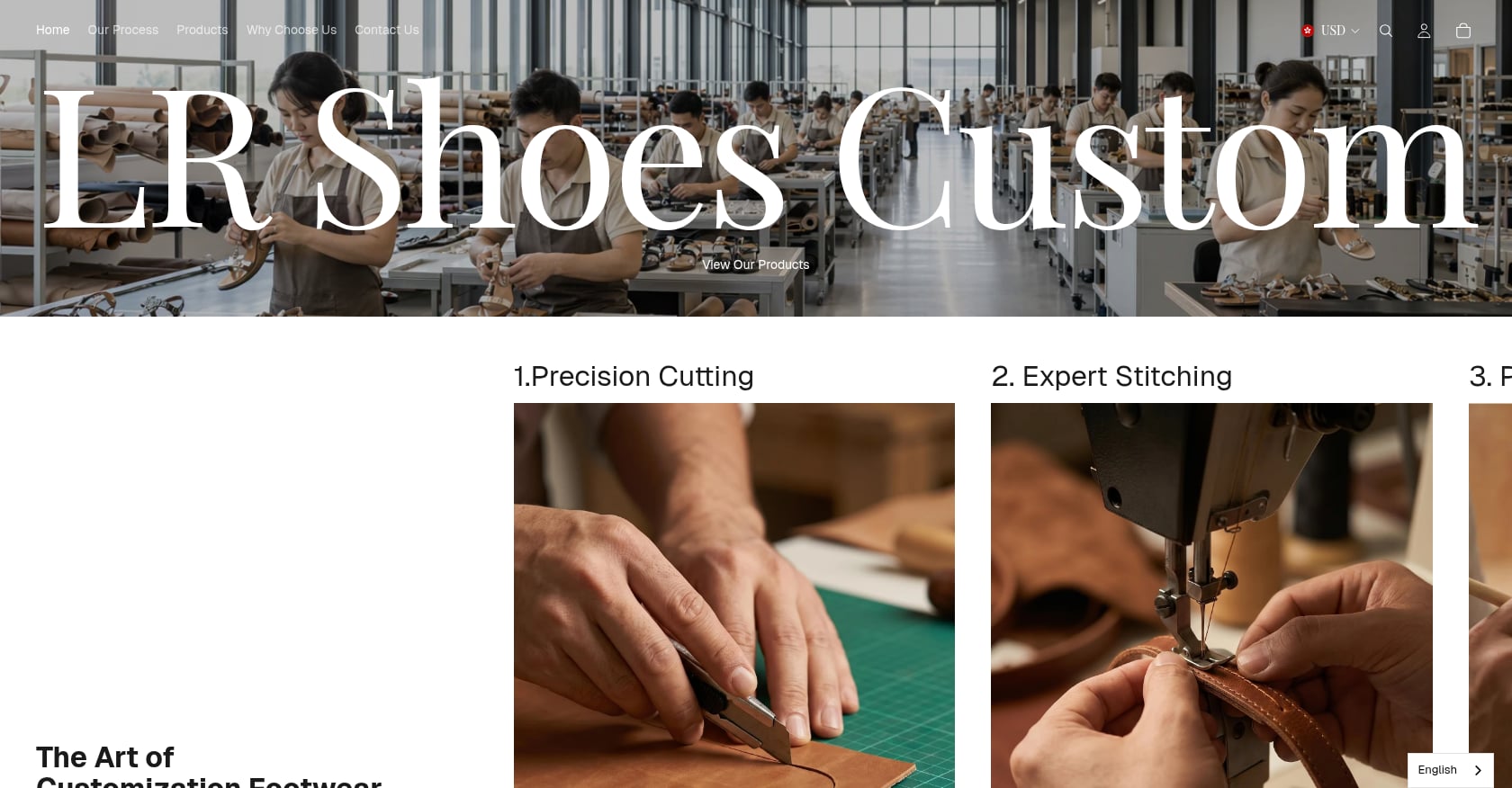
Best for: Women’s sandals, flats, and wedges with Western-market export compliance
LR Shoes Custom is a Shantou, Guangdong-based manufacturer specializing in women’s and girls’ footwear. Rather than operating a single massive factory, the company coordinates production across 20 cooperative core factories with a combined daily capacity of roughly 80,000 pairs. This subcontracting model gives them flexibility to handle diverse styles simultaneously.
Pricing:
- Core PU leather and fabric fashion sandals: $2–$6 FOB per pair
- Full product range: $1.50–$15 per pair
- Material and construction choices can create a $1–$3 price variance on the same style
Key features:
- Categories include women’s sandals, slippers, Mary Janes, espadrilles, wedges, heels, and boots
- Standard MOQ of 600 pairs per color, 800 pairs per style (1–3 colors), with trial orders negotiable below standard
- Fixed 35–50 day lead time for both standard and custom orders, even during peak season
- 20–30 new women’s designs released weekly, tracking US and EU trends
- 3-checkpoint QC process: raw material inspection, mid-production QC images and video, pre-loading inspection
- 24-hour anomaly response commitment
- Mandatory signed sample before mass production begins
Sample policy:
- Up to 10 single-foot or 5 paired samples free (freight collect, 7-day dispatch)
- Development or exclusive samples: $100–$300, fully deductible against bulk order
Compliance and export support:
- 17 years of export experience
- BSCI-audited factory claim
- US care labels and EU materials compliance documentation support
- Complete invoices and certificates per shipment
For a look at specific styles, the catalog includes everything from ethnic beaded cork sandals to metallic Mary Jane flats and espadrille wedge sandals.
Notable track record:
- 150,000-pair single-style order for a Spanish promotional sandal
- 80,000-pair pearl slipper order for the US market
Tradeoffs:
- MOQ of 600 pairs is higher than some competitors advertising 30–100 pairs
- Narrow category focus means no sneakers or men’s shoes
- No published certificate IDs for BSCI on-site
- No Trustpilot or Google review profile found
- Payment terms require 30% deposit for standard-credit countries, 50% for higher-risk countries
Deposit terms: 30% deposit for standard-credit countries; 50% for higher-risk countries with balance due before shipment.
Request free samples from LR Shoes Custom →
2. UM Footwear
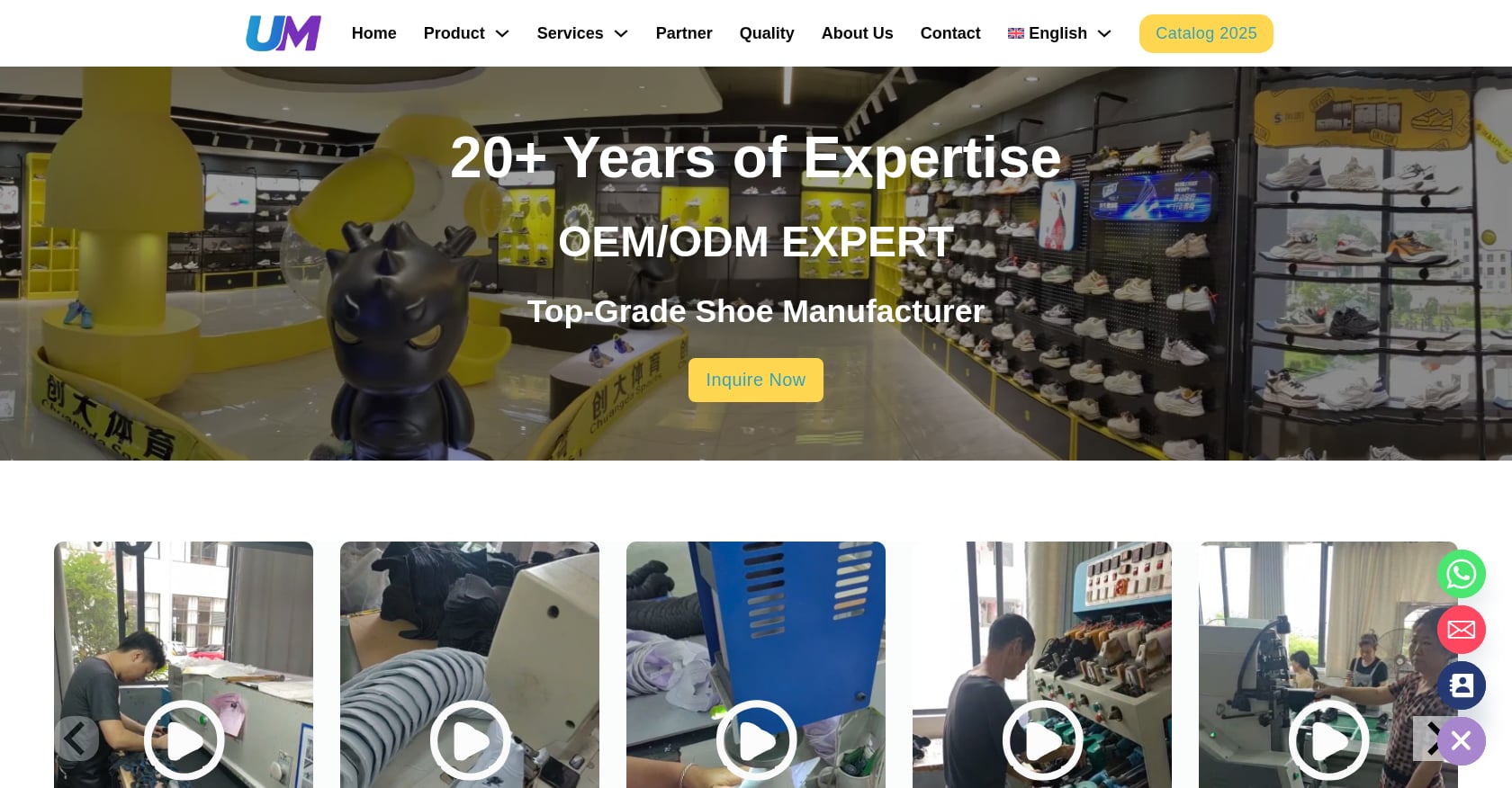
Best for: Broadest catalog selection across all shoe categories
UM Footwear is a China-based white label shoe manufacturer with over 13 years of experience, certified by BSCI and ISO 9001. Their pitch is volume and variety.
Key features:
- 1,000+ ready-to-brand designs including sneakers, casual shoes, fashion shoes, flyknit shoes, outdoor boots, kids’ shoes, roller skates, and sandals
- MOQ: 600 pairs per style
- Lead time: 3–5 weeks after order confirmation and QC approval
- Three manufacturing bases in Jiangxi, Fujian, and Yunnan covering over 180,000 square meters with 2,000+ employees
- Annual production capacity of 8 million pairs across 10+ production lines
- Claims partnerships with FILA, ZARA, Champion, and Merrell
Tradeoffs:
- Very broad catalog may mean less depth in any single women’s category
- Primary source of information is their own marketing copy; independent reviews are scarce
- Sneaker-heavy positioning may not suit brands focused exclusively on women’s fashion footwear
3. XinDeSheng (XDS)
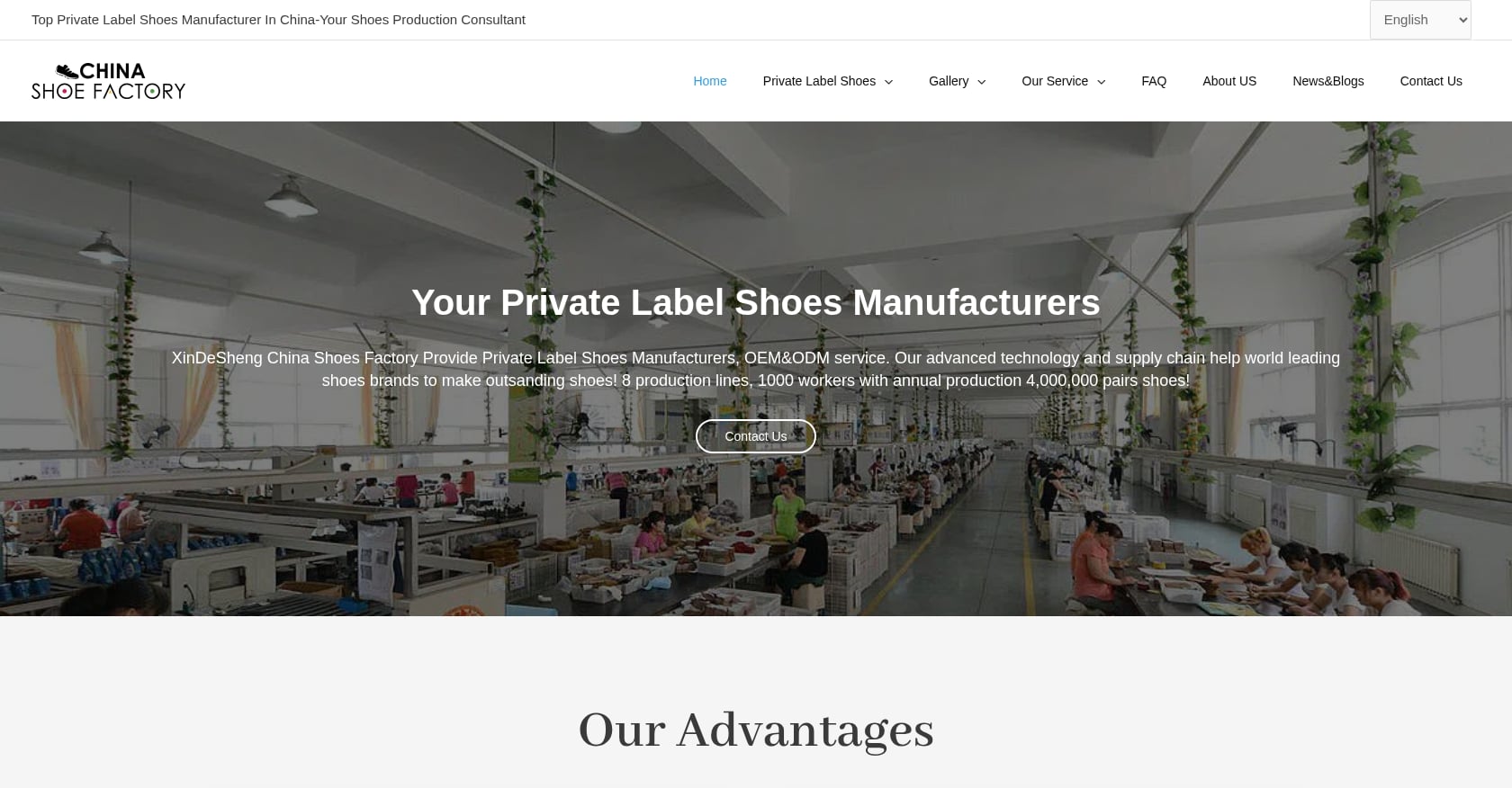
Best for: Sneakers and casual shoes with deep manufacturing experience
XinDeSheng (XDS) claims over 20 years of manufacturing experience specializing in white label and private label footwear for global clients.
Key features:
- Styles include sneakers, dress shoes, loafers, boots, and kids’ shoes
- Flexible MOQ starting at 500 pairs for select styles
- Advanced facilities and high-capacity production line
- Compliance with international standards (specific certifications not detailed)
Tradeoffs:
- Broad product range may not suit brands seeking deep specialization in one category
- Sneaker-heavy focus means women’s fashion sandals aren’t a stated strength
- Lead times not publicly listed, making planning harder before initial contact
4. KINGDI Shoes
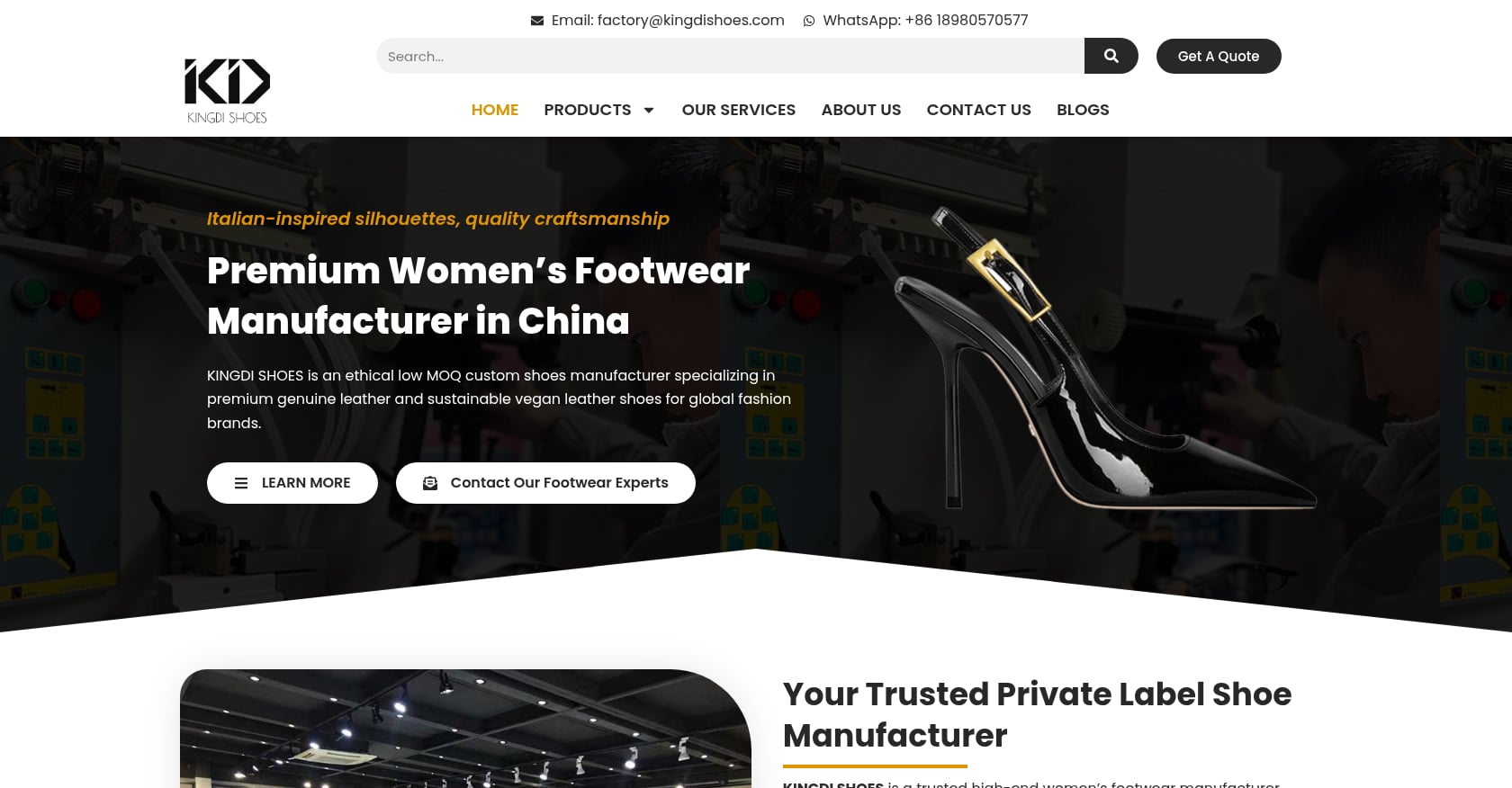
Best for: Premium genuine leather women’s footwear
KINGDI Shoes ranks well for white label shoe queries and positions itself as a premium women’s footwear manufacturer with ethical production claims.
Key features:
- Specializes in genuine leather women’s shoes
- Emphasizes ethical sourcing and production practices
- Targets brands wanting higher-end materials and positioning
Tradeoffs:
- Leather focus limits options for brands wanting PU, fabric, or mixed-material casual styles
- Pricing is likely higher per pair given genuine leather emphasis
- MOQ and lead time details are not publicly available
- Limited public information to evaluate before making contact
5. Alimao Footwear Group
Best for: Large-volume, full-range orders with an established exporter
Alimao stands out as one of China’s largest private label shoe exporters, with 27 years of experience dating back to 1998.
Key features:
- Covers men’s, women’s, and sneaker categories
- Scale-oriented production for large orders
- Nearly three decades of export experience
Tradeoffs:
- Scale orientation may not accommodate sub-1,000-pair orders comfortably
- General-purpose rather than niche, which can mean less specialized attention
- MOQ, lead times, and certifications are not published online
6. HYD Shoes
Best for: Work shoes and safety footwear with fast delivery
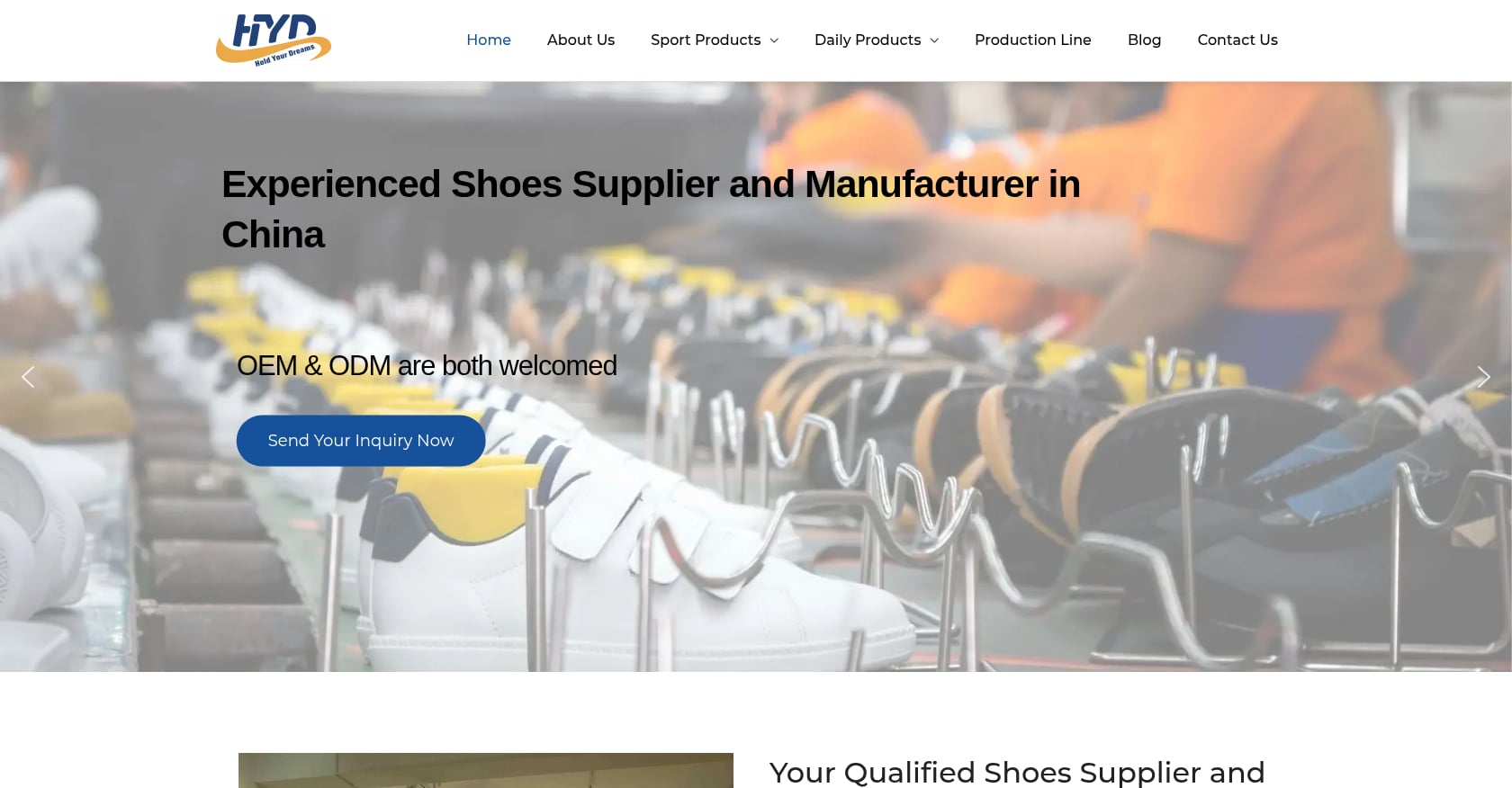
HYD Shoes is a versatile supplier with a dedicated team handling sales, sourcing, design, and quality control. Their differentiator is speed and flexibility.
Key features:
- Strong specialization in work shoes and safety footwear designed for demanding workplaces
- Claims low MOQ options
- Marketed as offering fast delivery
Tradeoffs:
- Work and safety shoe expertise doesn’t automatically translate to fashion footwear quality
- “Low MOQ” and “fast delivery” are vague without published numbers
- No certifications or compliance details listed publicly
7. COMUNITYmade
Best for: US-made ethical small-batch footwear
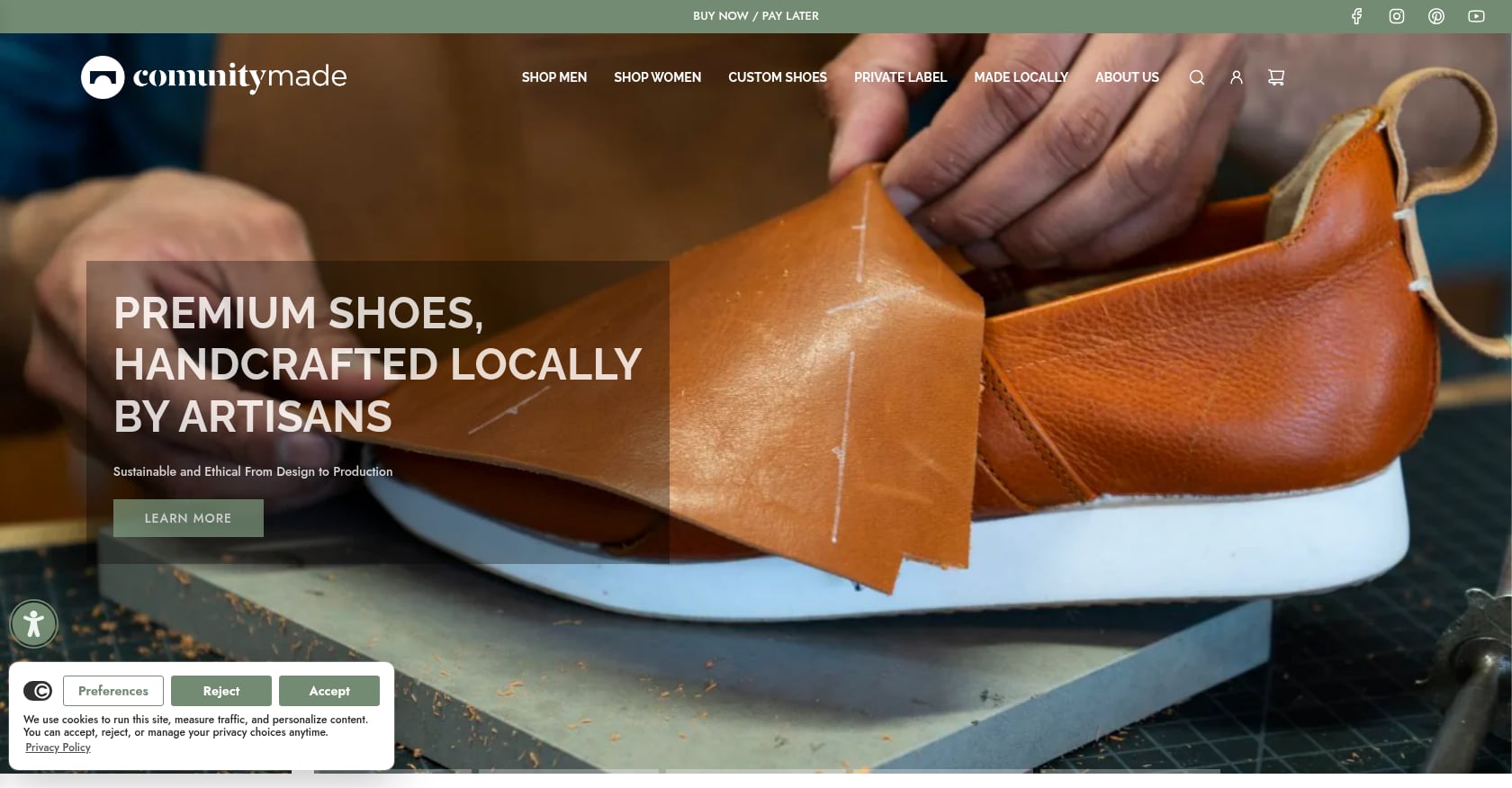
COMUNITYmade offers something rare: a full-service private label shoe manufacturing experience based in Los Angeles. This is the outlier on this list, designed for brands where “Made in USA” is central to the story.
Key features:
- US-based production with ethical labor practices
- Low minimum order quantities enabling experimentation with bold colors, unique textures, and seasonal drops
- Prototype, test, and launch within weeks rather than quarters
- Strong brand narrative for “Made in USA” positioning
Tradeoffs:
- Significantly higher per-pair cost than China-based factories
- Not a true white label model in the traditional sense, more private label and small-batch
- Not practical for brands competing primarily on price
- Limited to smaller production runs
How to Choose the Right White Label Shoe Manufacturer
Five Factors That Matter Most
1. Specialization match. A factory that produces 1,000+ styles across every category won’t have the same depth in women’s sandals as one that releases 30 new women’s designs every week. Match the factory’s core strength to your product line.
2. MOQ fit. Your first order should be sized to test demand, not warehouse inventory. If you’re planning 500 to 1,000 pairs, a factory that quietly expects 3,000-pair minimums will waste your time. Get the real number in writing before sending samples.
3. Compliance support. This is where first-time importers get burned. Footwear sold in the EU must meet restricted-substance limits under REACH regulations. Leather products need chrome and substance compliance testing. US-bound shipments require proper care labels. A factory that handles export documentation as standard service saves you from customs detention. For more on this, read this footwear compliance guide.
4. QC process. Ask for specifics. How many inspection checkpoints? Will you receive mid-production photos or video? What happens when a defect is found? A factory that mandates a signed sample before mass production is protecting both of you.
5. Communication responsiveness. Practitioners on buyer forums consistently rank this among their top concerns. If a factory takes five days to respond to a sample inquiry, imagine what happens when there’s a production problem at 3 AM their time.
Realistic Budget for a First Order
A practical budget breakdown for a small 500 to 1,000 pair white label shoe order looks like this:
| Cost Item | Range |
|---|---|
| Sampling | $300–$500 |
| Production (at lower MOQ pricing) | $1,200–$6,000 |
| Shipping (ocean freight/LCL) | $500–$1,500 |
| Customs clearance and duties | $200–$500 |
| Total | $2,200–$8,500 |
For full private label manufacturing with custom molds and exclusive designs, expect $15,000 to $25,000 for a 2,000-pair order including all costs.
Average shoe business profit margins run 20 to 30%, though the recommended target for footwear gross margin is typically 40 to 60% to account for returns, marketing, and seasonal markdowns.
Common Mistakes to Avoid
Choosing a manufacturer based only on the lowest price often leads to cheap materials, weak soles, and irregular stitching. These problems don’t just reduce the lifespan of the shoes; they destroy brand trust with your first batch of customers.
Skipping product sample testing is another frequent error. Things that look great in catalog photos can turn out to look and feel completely different in reality. Alibaba’s buyer guidance specifically recommends testing wearability, stitching integrity, and odor (a sign of poor adhesives).
Buyer forums surface another recurring concern: can the supplier reliably reproduce the same shade of white or exact sole thickness across future orders? Inconsistent dye lots or sole molds undermine brand trust over time. Always ask about batch-to-batch consistency before committing to a long-term relationship.
Sample Testing Checklist
Before approving mass production, check these on every sample pair:
- Sole adhesion (pull test between sole and upper)
- Cushioning and wear resistance
- Stitching uniformity and thread tension
- Material feel and finish quality
- Odor (chemical smell indicates poor adhesives)
- Sizing accuracy against your spec sheet
- Color consistency between left and right shoe
- Hardware durability (buckles, eyelets, studs)
Why Women’s Fashion Footwear Is the Smartest White Label Niche in 2026
The numbers tell a clear story. Women’s footwear accounted for 48% of the global footwear market in 2025, translating to roughly $180 billion in sales. The casual footwear segment held the largest market share at 46% in 2024, and that category maps directly to the sandals, flats, and wedges that most white label factories specialize in.
The global footwear market was valued at $476.8 billion in 2025 and is projected to grow to $675.6 billion by 2033, at a CAGR of 4.5%. Non-luxury products contribute 94% of footwear sales, which is exactly the segment where white label plays.
The competitive picture is favorable too. The market is highly fragmented: top global brands hold just 35% share, while local and independent players represent 47%. That fragmentation creates real space for private and white label entrants who can move quickly on trends.
Women’s fashion footwear has another structural advantage for white label brands: trend refresh speed. Unlike sneakers or work boots, which change gradually, women’s sandals and flats cycle through new trends every season. A factory that releases new weekly styles tracking US and EU trends gives its brand partners a constant stream of fresh inventory without the cost or risk of custom development.
This is why a women’s-focused factory often outperforms a generalist for brands in this category. The depth of style options, material knowledge, and trend awareness in women’s wedges and heels or flats and loafers simply doesn’t exist at a factory whose primary output is men’s sneakers.
Choosing Your Next Step
If you’ve read this far, you likely have a shortlist forming. The right manufacturer depends on your category focus, order volume, and how much compliance support you need. For brands building around women’s seasonal footwear with Western market ambitions, fixed lead times and structured QC processes matter more than the lowest possible per-pair price.
Get a quote or request samples from LR Shoes Custom →
FAQ
What are white label shoes?
White label shoes are pre-designed footwear produced by a manufacturer that multiple brands can purchase, rebrand with their own logo and packaging, and sell as their own product. The design isn’t exclusive to any single buyer, which keeps costs low and lead times short.
How much do white label shoes cost?
FOB prices for white label shoes from China typically range from $1.50 to $15 per pair depending on materials and construction. Basic PU leather and fabric fashion sandals fall in the $2 to $6 range. A 600-pair first order at these prices means $1,200 to $3,600 in production costs before shipping and duties.
What’s the minimum order for white label shoes?
Most China-based manufacturers set MOQs between 500 and 600 pairs per style or color. Some advertise lower minimums (30 to 100 pairs), but those typically come with higher per-pair pricing or limited style options. Trial orders below standard MOQs are sometimes negotiable.
Can I sell white label shoes on Amazon or Shopify?
Yes. White label shoes are legal to sell on any platform as long as you comply with the platform’s listing requirements, provide accurate product descriptions, and meet the import regulations of your target country (US care labels, EU REACH compliance, etc.). Many white label shoe brands operate primarily through Shopify stores or Amazon FBA.
What’s the difference between white label and private label shoes?
White label shoes use existing factory designs that any brand can rebrand. Private label shoes are designed or customized exclusively for one brand, offering more control over materials, colors, and construction. Private label typically requires higher MOQs (500 to 2,000+ pairs) and longer lead times (6 to 10 weeks) compared to white label.
How long does white label shoe production take?
Typical lead times for white label shoes range from 3 to 5 weeks. Some manufacturers offer fixed timelines; for example, LR Shoes Custom commits to 35 to 50 days for both standard and custom orders regardless of season. Private label and OEM orders take longer, typically 6 to 16 weeks.
What compliance documentation do I need to import shoes?
For US imports, you need proper care labels with fiber content and country of origin. EU-bound footwear must meet REACH restricted-substance limits, and leather shoes require chrome and substance compliance testing. Safety footwear sold in Europe needs EN standard certification and CE marking. Working with a factory experienced in export documentation significantly reduces your customs risk.
How do I verify a white label shoe manufacturer is legitimate?
Request samples before any bulk order. Ask for specific certification IDs (not just logos on a website). Check third-party import databases for shipping records. Visit the factory or hire a sourcing agent for an on-site inspection. And always insist on a signed production sample before mass manufacturing begins, since this protects you from sample-to-bulk quality drift.
0 comments