
TL;DR
ODM shoes let you skip the expensive design phase and launch a branded footwear line using factory-developed styles. The global footwear OEM/ODM market is worth $92 billion in 2026 and growing at 5.8% annually. This guide compares seven ODM shoe manufacturers, explains real pricing ($2 to $6 per pair for PU fashion sandals), and walks you through the exact process of choosing, vetting, and ordering from an ODM partner. If you sell women’s sandals, flats, or wedges, start by browsing ODM-ready styles to see what’s possible before committing capital.
Why ODM Shoes Are the Default Launch Model in 2026
Half a decade ago, ODM manufacturing was considered a shortcut for startups who couldn’t afford their own design team. That perception has shifted dramatically. According to Business Research Insights, roughly 50 to 60 percent of new large-brand contracts now start as ODM-first programs. ODM is not a compromise. It is a strategic phase.
The math explains why. OEM development (where you supply your own designs) requires $5,000 to $50,000 in tooling costs, 8 to 20 weeks of development time, and minimum orders often exceeding 1,000 pairs per style. ODM flips those numbers: no tooling fees, 4 to 8 weeks from order confirmation to production, and MOQs that can start in the 200 to 600 pair range.
For context, the global footwear OEM and ODM market sits at USD 92.12 billion in 2026 and is projected to reach $131.72 billion by 2034. China alone produces 50 to 55 percent of the world’s footwear pairs, with Guangdong, Fujian, and Zhejiang provinces serving as the primary manufacturing hubs. If you’re sourcing ODM shoes, you’re almost certainly sourcing from China, and understanding the regional specializations matters.
ODM vs. OEM vs. Private Label: What’s the Difference?
Before comparing manufacturers, the terminology needs to be clear. These three terms get used interchangeably, but they describe different arrangements with different implications for cost, timeline, and intellectual property.
ODM (Original Design Manufacturer): The factory designs the shoe. You select from its existing catalog, choose your colorway, materials, and branding, and the factory produces under your label. The factory owns the base design and may sell the same pattern to other brands unless you negotiate exclusivity.
OEM (Original Equipment Manufacturer): You supply the design. The factory provides manufacturing capability only. You own the design IP, and the resulting product is exclusive to your brand. This requires an in-house design team or hired footwear designer.
Private Label: This is a business model, not a manufacturing method. Private-label brands sell factory-made products under their own name. The products can be sourced through either ODM or OEM arrangements. Most private-label shoe brands start with ODM and graduate to OEM for their bestselling styles.
| Factor | ODM | OEM |
|---|---|---|
| Who designs | Factory | Your team |
| Design ownership | Factory | You |
| Tooling costs | None | $5,000 to $50,000 |
| Typical MOQ | 200 to 600 pairs | 600 to 3,000+ pairs |
| Sample to production | 4 to 8 weeks | 8 to 20 weeks |
| Exclusivity | Shared unless negotiated | Automatic |
| Best for | Startups, market testing, seasonal fills | Established brands, signature products |
Practitioners on a footwear sourcing blog put it well: “Most ‘factory problems’ are actually stage mismatch problems.” A brand with no sales history demanding OEM exclusivity is overpaying for something that doesn’t matter yet. A brand doing 50,000 pairs annually on shared ODM designs is leaving margin and differentiation on the table.
At-a-Glance Comparison: 7 Best ODM Shoe Manufacturers
| Manufacturer | Specialization | MOQ | Lead Time | Key Certification | Best For |
|---|---|---|---|---|---|
| LR Shoes Custom | Women’s sandals, flats, wedges | 600 pairs/color | 35 to 50 days (fixed) | BSCI | Private-label sandals, US/EU export |
| XINZIRAIN | Women’s fashion shoes | From 50 pairs | Varies | Not stated | Low-MOQ startups |
| KingDi Shoes | Leather women’s shoes | Quote-based | Varies | Not stated | Premium leather brands |
| XinDeSheng | Sports, casual, eco shoes | Quote-based | Varies | Not stated | Eco and sports brands |
| HYD Shoes | Multi-category | Quote-based | Varies | Not stated | Diversified catalogs |
| UMFootwear | Athletic and fashion | Higher (scale factory) | 45 to 60 days | BSCI, ISO9001 | High-volume established brands |
| Best Shoe Factory | Multi-category | From 10 pairs | Varies | Not stated | First-time founders |
The 7 Best ODM Shoe Manufacturers in 2026
1. LR Shoes Custom
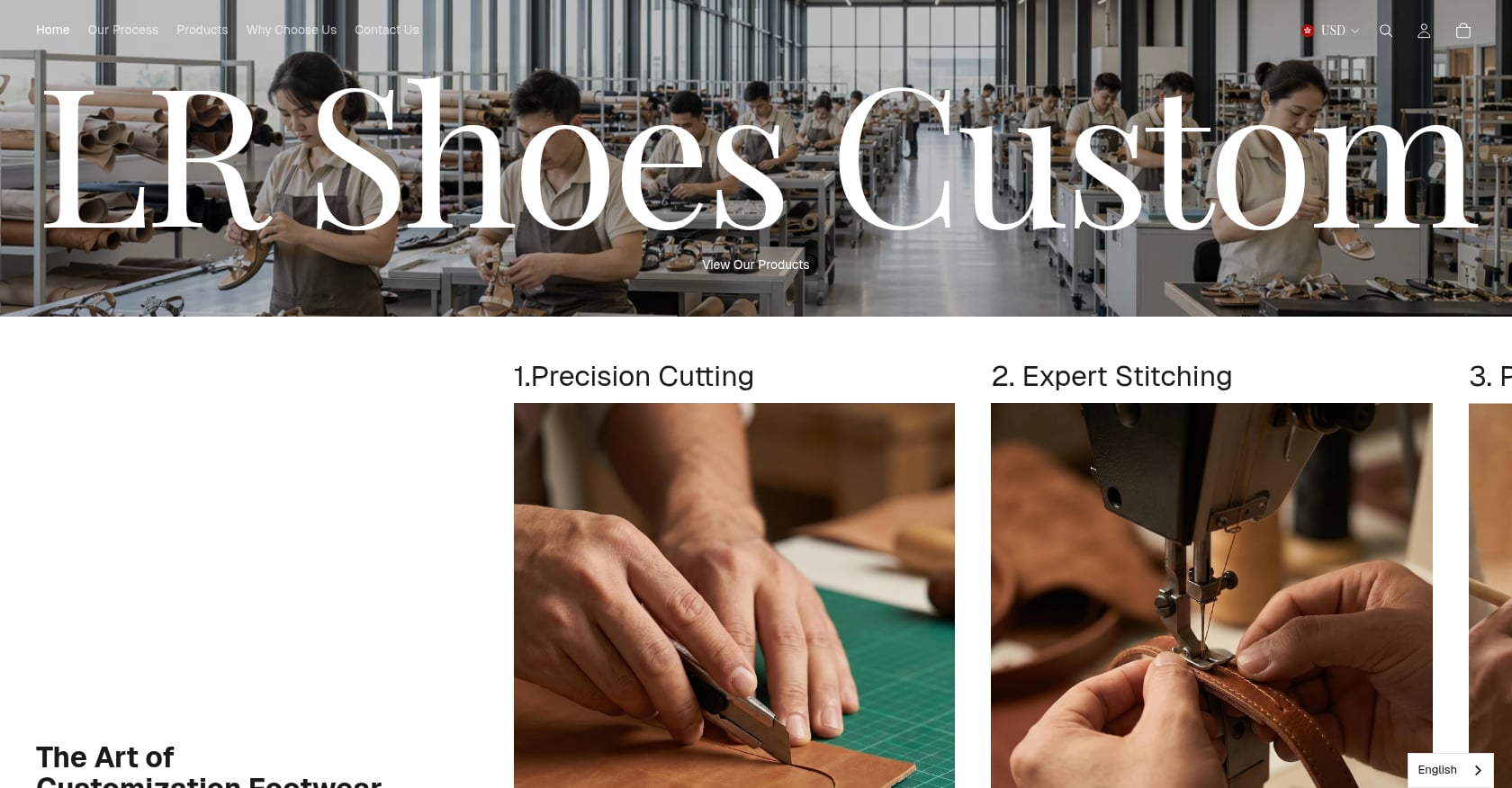
Best for: Private-label brands sourcing women’s sandals, flats, and wedges for US and EU markets.
LR Shoes Custom is a Shantou, Guangdong-based ODM and OEM supplier with 17 years of export experience. The company focuses specifically on women’s and girls’ footwear: sandals, flats (including Mary Jane and espadrille styles), wedges, heels, slippers, and boots.
What sets LR apart from generalist factories is the combination of specialization, compliance infrastructure, and pricing transparency that most competitors lack.
Pricing (first-party data):
- Overall FOB range: $1.50 to $15 per pair
- Core PU/fabric fashion sandals: $2 to $6 per pair
- Material and construction differences on the same sandal can create a $1 to $3 per pair variance
These are real numbers. No other ranking page in this space publishes concrete ODM shoe pricing benchmarks, which leaves buyers guessing until they’ve already invested time in factory conversations.
Key specs:
- MOQ: 600 pairs per single color, 800 pairs for 1 to 3 colors. Trial orders have relaxed minimums.
- Lead time: Fixed 35 to 50 days, even during peak season.
- Sampling: Up to 10 single-foot samples (or 5 paired samples) free, freight collect, with 7-day dispatch. Exclusive or complex customs or quantities over 10 samples: $100 to $300, fully deductible from bulk orders.
- Payment: 30% deposit standard; 50% deposit for higher-risk countries; balance before shipping. No zero-deposit first orders.
- Capacity: 20 core cooperative factories with combined daily output of 80,000 pairs.
- Catalog refresh: The in-house development team releases 20 to 30 new styles weekly, tracking US and EU trends. You can see the latest new arrivals to get a sense of the pace.
Quality control process:
LR runs a three-stage inspection system: raw material check, mid-production photos and video, and a pre-loading inspection report. This level of QC visibility is unusual for factories at this price point.
Compliance:
BSCI-audited factory. Supports US care label placement and EU materials rules. Prepares complete invoices and certificates per shipment. For brands shipping to the US or EU, this compliance infrastructure matters more than most buyers realize until their first customs detention. For a deeper dive, see this footwear compliance checklist covering US, EU, and UK rules.
Proof points:
- 150,000-pair single-style order for a Spanish client
- 80,000-pair pearl slipper production run for the US market
- Recent bestsellers include pearl styles, plum-blossom metal buckle designs (US), and ring-buckle styles (Poland)
Limitations:
- The 600-pair MOQ is higher than competitors advertising 30 to 90 pairs, though those ultra-low MOQs typically come with significant per-pair premiums and less structured QC.
- Category specialization in women’s sandals, flats, and wedges means this is not the right factory for men’s shoes, athletic footwear, or heavy boots.
- No publicly verifiable BSCI certificate ID on the website.
Honest trade-off: You pay more per order (higher MOQ) but get fixed lead times, structured quality control, and export compliance support that reduces downstream risk.
Request samples or a quote from LR Shoes Custom
2. XINZIRAIN
Best for: Small brands and independent designers who need very low MOQs and hands-on development support.
XINZIRAIN is a China-based women’s shoe manufacturer with more than 25 years of experience in footwear development and export manufacturing. The company positions itself as a professional OEM and ODM manufacturer specializing in custom footwear and private-label shoe production for international brands, wholesalers, and designers.
Key specs:
- MOQ starting from 50 pairs (per their website)
- Sub-brand HERRAINS handles content marketing and maintains a strong blog presence
- Focus on brand-driven footwear development rather than mass athletic production
Limitations:
- Low MOQs almost always mean higher per-pair costs. A 50-pair order will cost significantly more per unit than a 600-pair order.
- Ultra-low minimums sometimes indicate a trading company model rather than direct factory access, which can add a middleman layer to communication and quality control.
- No certifications prominently stated on-site.
3. KingDi Shoes
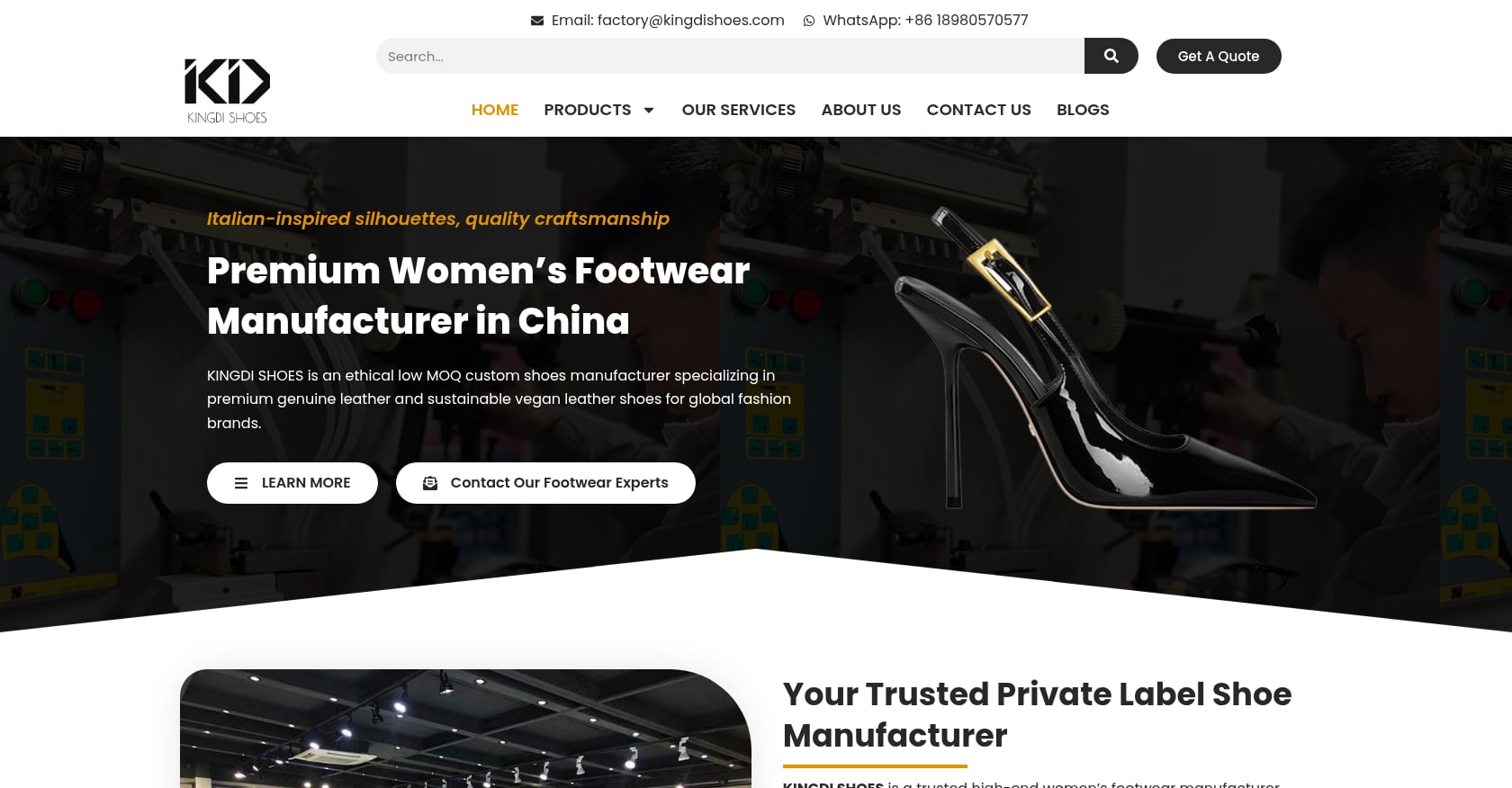
Best for: Brands seeking genuine leather and premium-material women’s footwear with a handmade positioning.
KingDi covers a full range of OEM/ODM women’s footwear including genuine leather, vegan leather, and exotic leather styles. Their positioning emphasizes handmade construction and premium materials.
Key specs:
- Private-label focus across leather and vegan leather categories
- Direct manufacturer with handmade shoe positioning
- Full women’s footwear range
Limitations:
- Leather specialization may limit capability in trend-driven PU or fabric fashion sandals at lower price points.
- MOQ and lead time details are not publicly listed, requiring direct inquiry.
- Less relevant for brands focused on affordable, fast-fashion sandals.
4. XinDeSheng (TopFactoryShoes)
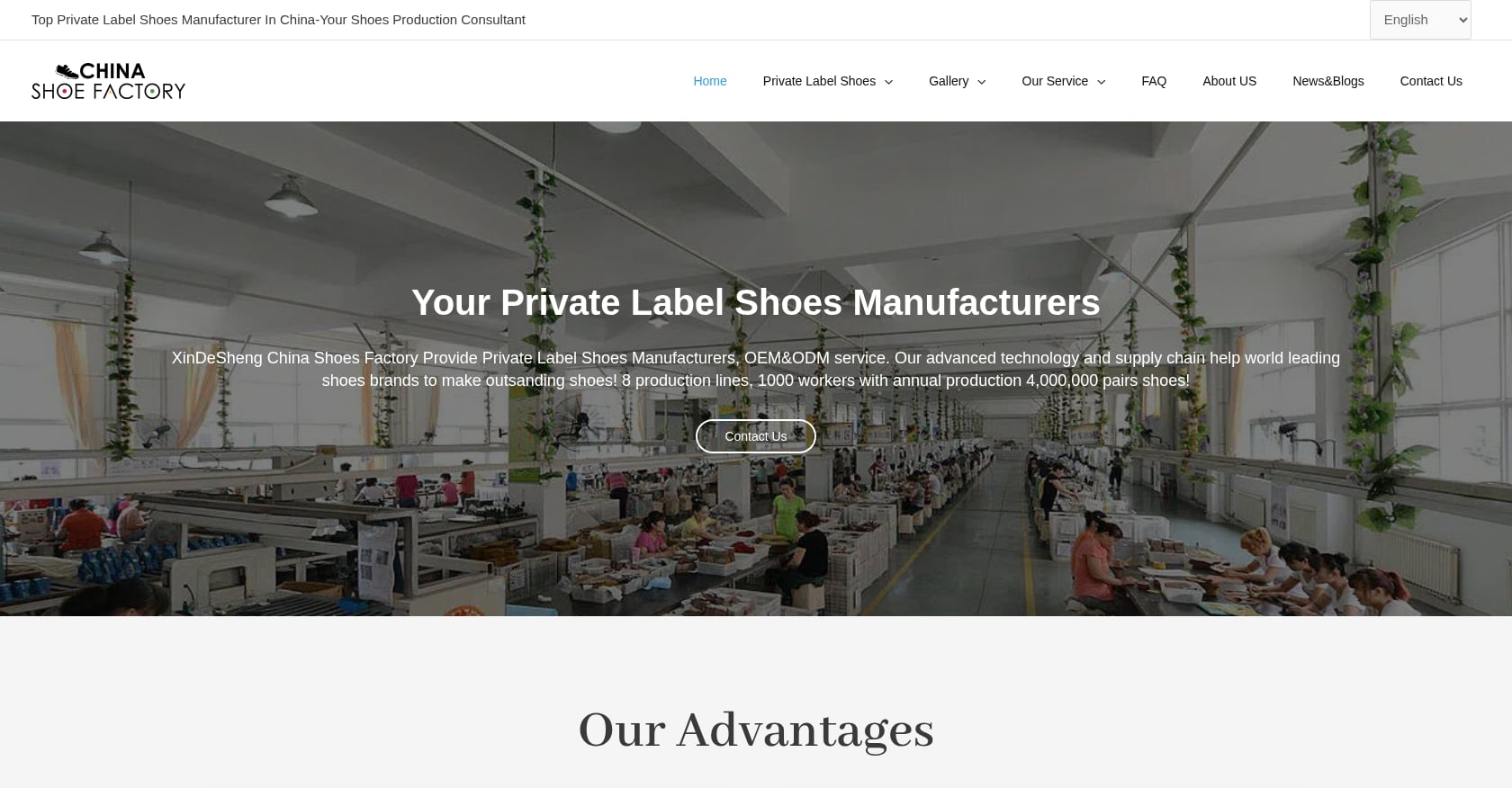
Best for: Brands wanting sports and casual ODM shoes with eco-friendly material options.
XinDeSheng operates 8 production lines with 1,000 workers, producing approximately 4 million pairs annually. The company offers recycled material, bio-based material, and eco-friendly material options across a broad range of categories.
Key specs:
- Categories: sports, running, hiking, sneakers, LED shoes, canvas, slippers, kids’ shoes
- Eco-material positioning for sustainability-conscious brands
- Large-scale production capacity
Limitations:
- Very broad product range suggests a generalist approach. As practitioners in the footwear industry point out, sneakers, leather dress shoes, sandals, and boots are made by different specialist factories with different constructions and skills. A sneaker factory cannot Goodyear-weld a dress shoe.
- Not a women’s fashion specialist.
- MOQ and pricing require direct inquiry.
5. HYD Shoes
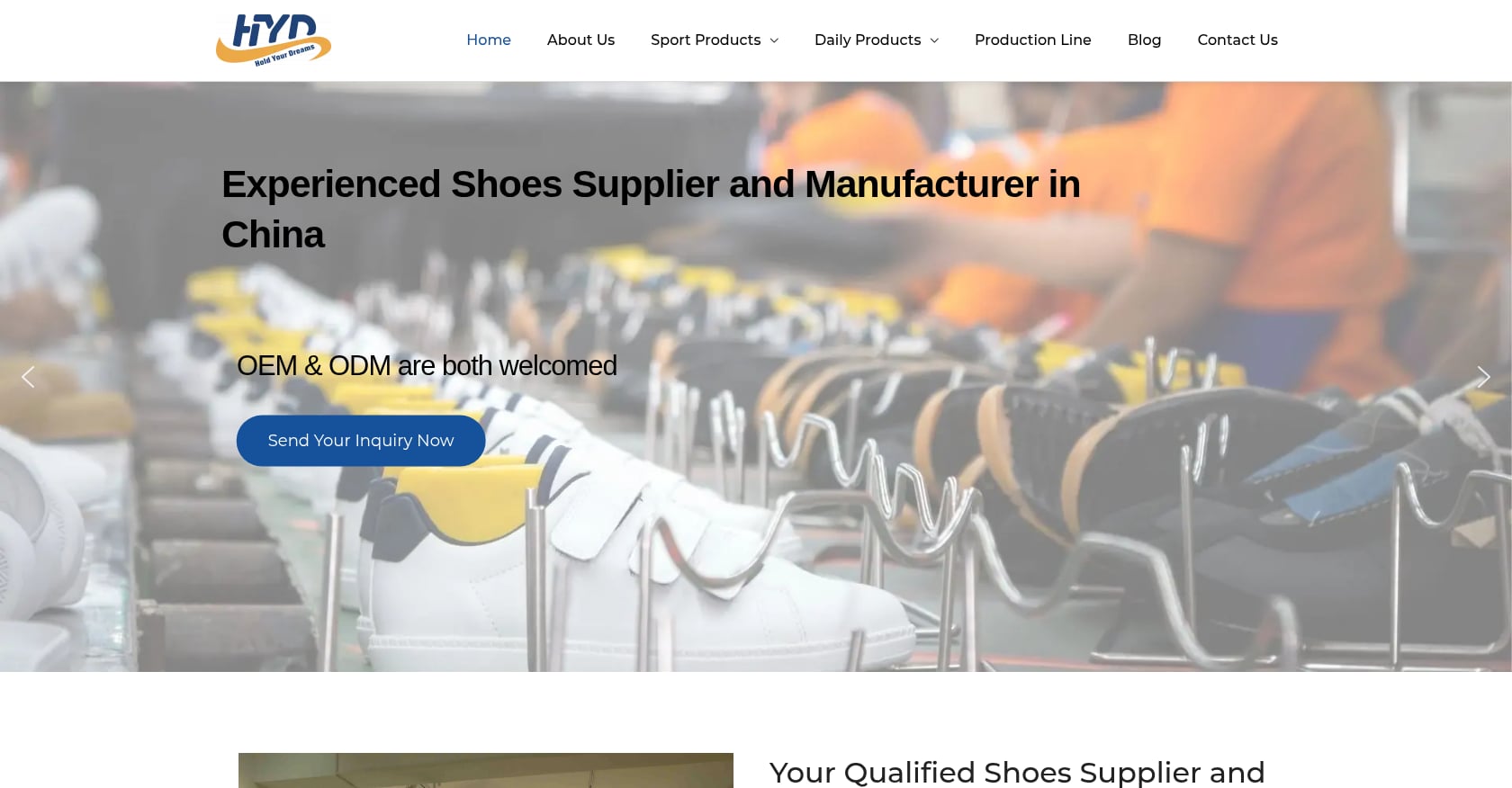
Best for: Brands needing diverse shoe categories from a single supplier.
HYD Shoes, based in Guangzhou, brings 12+ years of experience in OEM shoe manufacturing. The company covers multiple categories including boots, loafers, and equestrian shoes. They emphasize that products are 100% made inside their factory.
Key specs:
- Multi-category production (boots, loafers, equestrian, sandals)
- In-house manufacturing (no outsourcing)
- 12+ years of OEM experience
Limitations:
- Jack-of-all-trades positioning raises the specialist question. A factory that makes equestrian boots, loafers, and sandals under one roof is likely making trade-offs somewhere.
- No certifications prominently listed.
- Pricing and MOQ details not publicly available.
6. UMFootwear
Best for: Established brands with higher volume needs and strict compliance requirements.
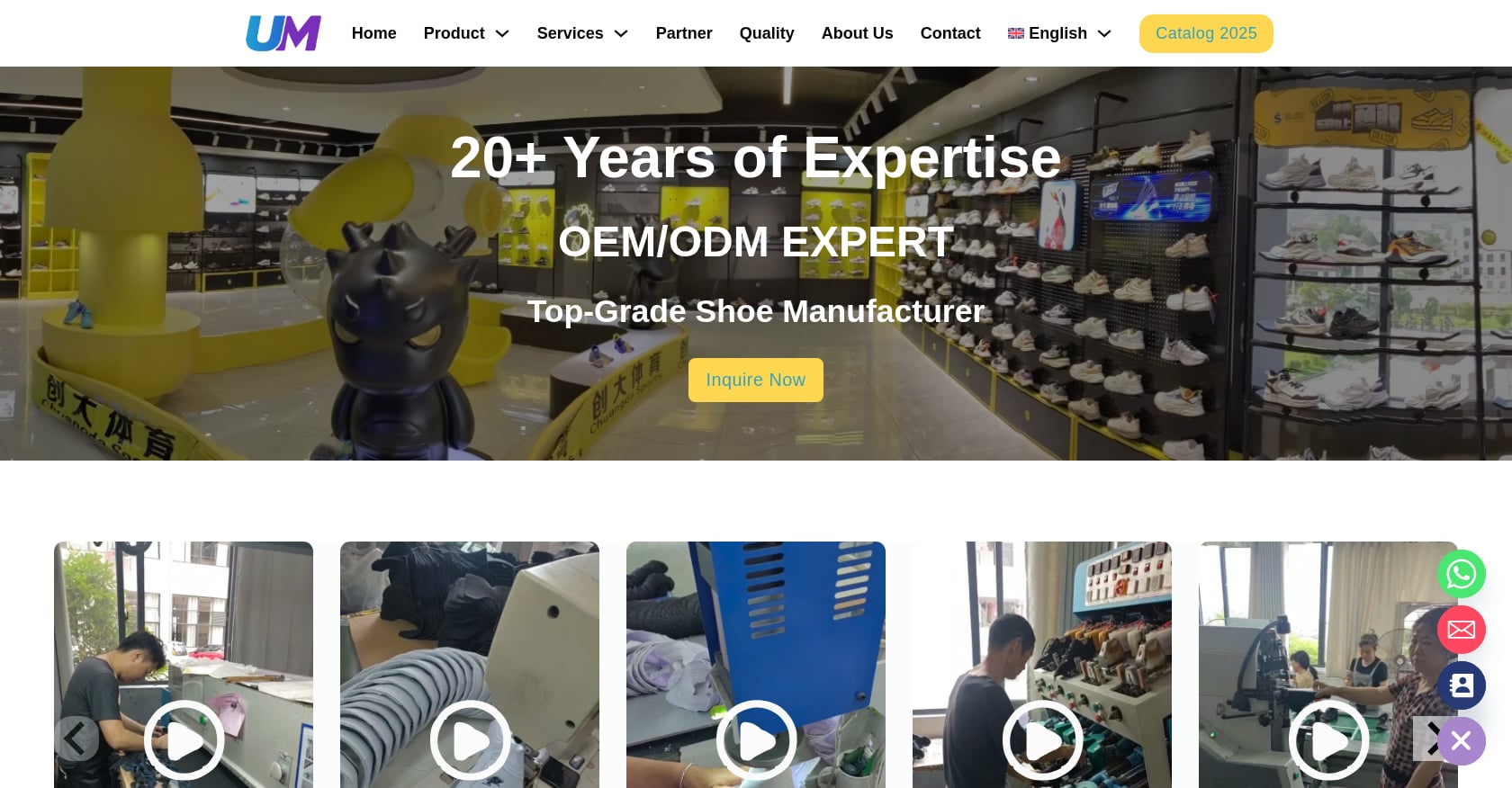
UMFootwear is a technology-driven footwear manufacturer with 13+ years of experience. The company is certified by BSCI and ZARA GTW, holds ISO9001 certification, and works with global brands including FILA, ZARA, Champion, Umbro, and Saucony.
Key specs:
- 3 large-scale factories in Jiangxi, Fujian, and Yunnan
- 12 advanced production lines, over 8 million pairs annually
- OEM manufacturing lead time: 45 to 60 days
- Payment: 30% TT deposit and 70% balance on copy of B/L
- Named brand clients provide credibility signal
Limitations:
- Scale implies higher MOQs, making this likely unsuitable for small trial orders.
- The 45 to 60 day lead time is longer than some competitors.
- Primarily serves larger brands, so smaller buyers may not receive priority attention.
7. Best Shoe Factory
Best for: First-time founders testing a concept with minimal capital.
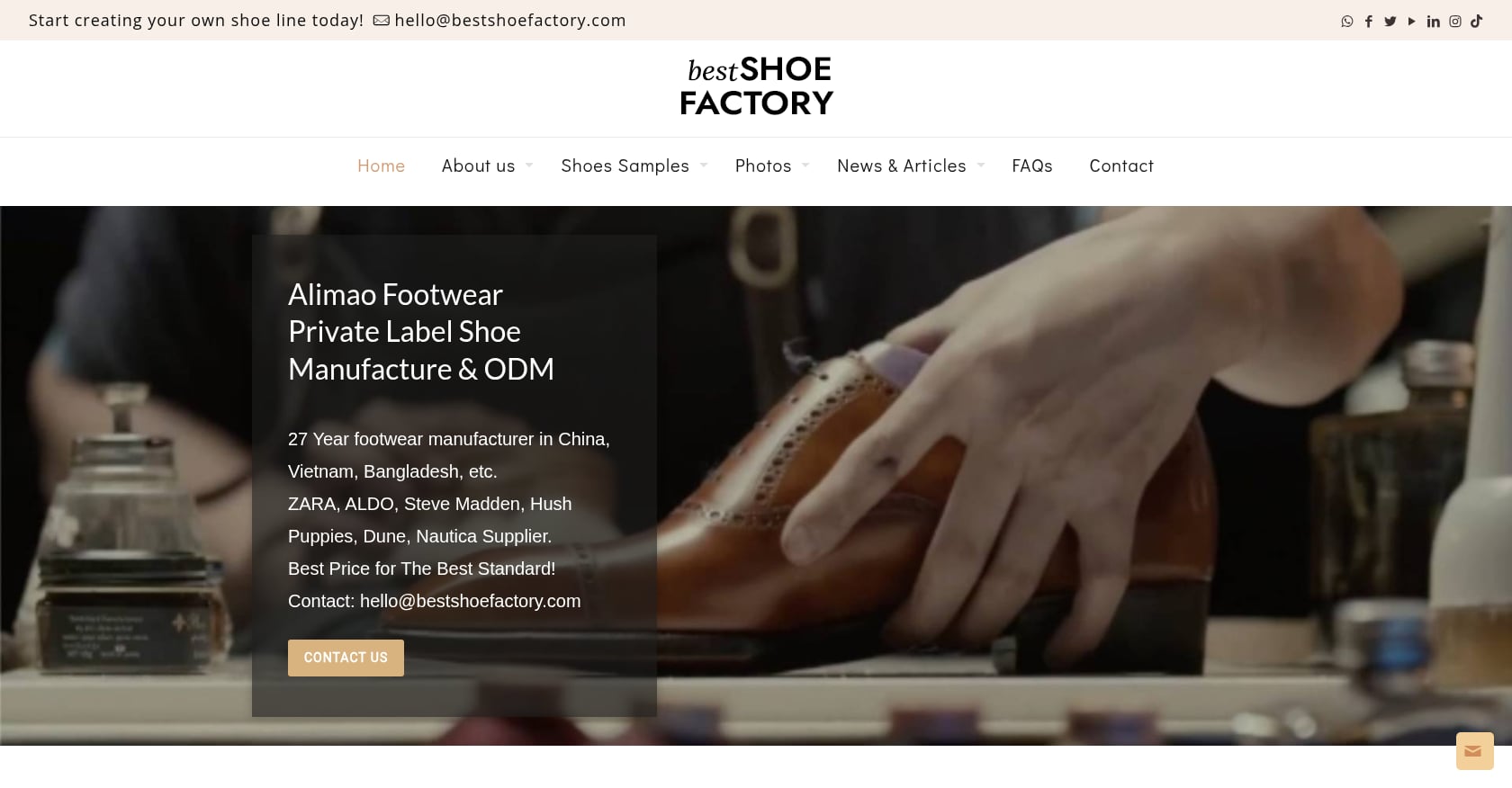
Best Shoe Factory positions itself as a “low MOQ shoe manufacturer” with minimums as low as 10 pairs. This ultra-low barrier to entry is designed for startup founders and Kickstarter-style launches.
Key specs:
- MOQ as low as 10 pairs
- Targets startup founders
- Simple ordering process with direct CTA
Limitations:
- 10-pair MOQs almost certainly carry significant per-pair premiums. According to Wonnda’s private-label research, typical custom shoe MOQs run 400 to 1,000 pairs per style and color. Anything dramatically below that threshold should prompt questions about how the economics work.
- Quality consistency at micro-batch volumes is a known industry risk.
- No certifications or compliance infrastructure mentioned.
What Do ODM Shoes Actually Cost?
This is the question every buyer wants answered, and almost no manufacturer or guide publishes real numbers. Here are concrete benchmarks based on first-party data from the women’s fashion sandal segment:
| Category | FOB Price Range |
|---|---|
| PU/fabric fashion sandals (core ODM category) | $2 to $6 per pair |
| Full range including premium styles | $1.50 to $15 per pair |
| Material/construction variance on same design | $1 to $3 per pair difference |
For comparison, OEM development adds $5,000 to $50,000 in tooling costs on top of per-unit production costs, according to the Alibaba Seller Blog.
The pricing gap between ODM and OEM is not just about per-pair cost. It’s about total cash at risk. An ODM order of 600 pairs at $4 per pair ties up $2,400 in product cost (plus deposit, shipping, and duties). An OEM program with custom tooling, sampling, and a 1,500-pair minimum can require $15,000 to $30,000 before a single pair ships to a customer.
When sourcing practitioners on Reddit discuss ODM pricing, a consistent theme emerges: you have to specify exactly how good you want your materials. Chinese factories understand quality tiers perfectly well, but if you don’t explicitly request mid-grade or top-grade materials, you may receive the lowest acceptable option. The $1 to $3 variance on the same sandal design comes down almost entirely to material grade selection.
To see specific styles and get a sense of material and construction options, browse the sandals collection for examples ranging from basic slides to embellished wedges.
How to Choose the Right ODM Shoe Partner: 7-Point Checklist
Finding a factory is easy. Finding the right factory for your specific stage, category, and target market is the hard part. This checklist covers the factors that separate a productive partnership from an expensive lesson.
1. Specialization Match
Does the factory specialize in your product category? A factory that excels at women’s fashion sandals is not the same factory you’d choose for men’s hiking boots. The construction methods, materials knowledge, and lasts are completely different. Look for a factory whose catalog already features products similar to what you want to sell.
2. MOQ Alignment
Match the factory’s minimum order to your actual sales projections, not your wishful thinking. If you can realistically sell 600 pairs of a style in your first season, a 600-pair MOQ works. If you can only sell 100 pairs, either find a lower-MOQ factory (and accept higher per-pair costs) or question whether you’re ready to launch that product.
3. Sample Policy and Timeline
The Shoemakers Academy notes that sample production and costing information from some factories can take as long as 60 days. That timeline can kill a seasonal launch. Look for factories that commit to specific sample dispatch windows. A 7-day sample dispatch is significantly faster than the industry average and signals an organized operation.
Red flags in sample policies: charging non-deductible sample fees, refusing to send physical samples before bulk orders, or requiring full minimum orders before sampling.
4. QC Process
Ask exactly how many inspection stages the factory uses and what documentation you’ll receive. The benchmark is three stages: raw material inspection, mid-production quality check (with photos or video), and a pre-loading inspection report. If a factory can’t describe their QC process in detail, that tells you something.
5. Compliance and Export Documentation
This is the area where most ODM shoe articles go silent, and it’s where the most expensive surprises happen. Before placing an order, confirm:
- Does the factory handle US care label placement?
- Are materials EU REACH-compliant?
- Is the factory BSCI or SMETA audited?
- Will they prepare complete invoices and certificates per shipment?
- Do they have experience clearing customs in your target market?
A single customs detention can cost more than the entire order in delays, storage fees, and lost sales. Compliance is not a nice-to-have.
6. Communication Responsiveness
Practitioners from the Shoemakers Academy recommend getting off WeChat and onto email where conversations are easier to search and organize. Test response times before placing your first order. A factory that takes three days to reply during the courtship phase will take longer once they have your deposit.
Look for factories offering multiple channels (WhatsApp, email, WeChat) with a stated response commitment. A 24-hour anomaly response window is a strong signal.
7. Payment Terms Transparency
Standard ODM shoe payment terms are 30% deposit with the balance before shipping. Be wary of factories that ask for unusual arrangements (full payment upfront, cryptocurrency, Western Union). Similarly, be realistic: no reputable factory offers zero-deposit terms to first-time buyers. If someone is willing to produce hundreds of pairs with no deposit, ask yourself why.
Common ODM Sourcing Mistakes (and How to Avoid Them)
Choosing a generalist factory for a specialist product. If you’re launching a women’s sandal brand, don’t order from a factory whose main business is athletic shoes. The skills don’t transfer.
Not specifying material grade. Saying “good quality leather” or “nice PU” means nothing. Specify the exact material grade, finish, and thickness. Experienced buyers on Alibaba sourcing forums stress that Chinese factories understand “top tier” as the absolute best, but they’ll default to the cheapest acceptable option if you don’t specify.
Skipping signed sample approval before bulk. Never, under any circumstances, approve bulk production based on photos alone. Insist on a physical sample, inspect it, sign off on it, and keep it as your reference standard.
Over-modifying an ODM design without re-sampling. The whole point of ODM is that the design has been tested and refined. Changing the material on a shoe originally developed in leather can introduce fit or construction issues if the new material behaves differently. If you’re making significant modifications, treat it as a new development and request new samples.
Ignoring compliance documentation until customs detention happens. This is surprisingly common. Brands focus entirely on product and pricing, then discover at the port that their shipment lacks proper documentation. Build compliance verification into your factory selection process from day one.
The ODM-to-OEM Ladder: When and How to Upgrade
The smartest footwear brands treat ODM and OEM not as competing choices but as sequential stages. Here’s how the progression typically works.
Phase 1: ODM Launch. You select proven styles from the factory catalog, apply your branding, and test the market. Your investment is low, your speed to market is fast, and your risk is minimal. This is where you learn what your customers actually buy versus what you thought they’d buy.
Phase 2: Identify hero products. After one or two seasons, you’ll see which styles consistently sell. These are your candidates for OEM transition.
Phase 3: Secure exclusivity or transition to OEM. You have two options for your bestsellers. Option A: pay a design exclusivity fee that removes the style from the factory’s general catalog. Other brands can no longer order it. Option B: invest in full OEM development where you own the design IP entirely.
Phase 4: Maintain ODM for the rest. Even as your hero products move to OEM, keep using ODM for complementary styles, seasonal fills, and new category tests. Many large brands operate a hybrid model indefinitely.
This ladder approach means you never over-invest at the wrong stage. You use ODM to learn, OEM to differentiate, and the combination to scale. For example, you might start with cork Birkenstock-style sandals from the ODM catalog while developing a custom OEM design for your signature flat.
The factory you choose should support both paths. A manufacturer that only offers ODM can’t grow with you, and a factory that only does OEM will price you out of market testing.
FAQ
What does ODM mean in shoes?
ODM stands for Original Design Manufacturer. In footwear, it means the factory designs and develops the shoe, and brands select from the factory’s existing catalog. The brand applies its own logo, packaging, and sometimes modifies colors or materials. The factory retains ownership of the base design unless an exclusivity agreement is negotiated separately.
Are ODM shoes lower quality than OEM shoes?
No. Quality depends on the factory’s capabilities and QC processes, not on the ODM or OEM distinction. An ODM shoe from a well-run factory with rigorous three-stage inspection can be superior to an OEM shoe from a poorly managed one. In fact, ODM styles have often gone through multiple rounds of proofing and optimization, which can make them more reliable than a brand-new OEM design.
What’s a typical MOQ for ODM shoes?
MOQs vary widely. Industry standard for custom shoes runs 400 to 1,000 pairs per style and color, according to Wonnda. Some factories advertise minimums as low as 10 to 50 pairs, but these come with substantially higher per-pair costs. A 600-pair MOQ is typical for factories that offer structured QC, compliance support, and fixed lead times.
How much do ODM shoes cost per pair?
For women’s PU and fabric fashion sandals, the core ODM category, FOB prices typically range from $2 to $6 per pair. The full range across categories runs $1.50 to $15 per pair. Material and construction choices on the exact same sandal design can create a $1 to $3 per pair difference. These benchmarks come from a Guangdong-based manufacturer specializing in women’s sandals and flats.
Can I get exclusive designs through ODM?
Yes, but it costs extra. In a standard ODM arrangement, the factory may sell the same base design to multiple clients with different branding. If you want exclusivity, you can pay a design exclusivity fee that removes the style from the factory’s general catalog. Alternatively, you can transition that specific style into OEM development where you own the design outright. The exclusivity fee is almost always cheaper than full OEM development.
How long does it take to get ODM shoes produced?
Timelines vary by factory. Some manufacturers commit to fixed 35 to 50 day lead times even during peak season. Others quote 45 to 60 days for OEM manufacturing. For context, full OEM development including last and mold creation and multiple fit samples can run 90 to 150 days for a first production run. ODM’s speed advantage is one of its strongest selling points.
What compliance certifications should I look for in an ODM shoe factory?
At minimum, look for BSCI (Business Social Compliance Initiative) or SMETA audit certification. For EU-bound products, confirm materials are REACH-compliant. For US-bound products, verify the factory can handle proper care label placement. ISO9001 certification indicates standardized quality management systems. Beyond certifications, ask whether the factory prepares complete shipping documentation (invoices, certificates of origin, material declarations) per shipment.
Should my first shoe brand start with ODM or OEM?
ODM, almost always. For first collections, ODM gives you access to proven, pre-developed styles with tested materials and established fit. You get speed, lower financial risk, and a lower MOQ. As your brand grows and you identify which styles resonate with customers, you can transition specific products to OEM development. Starting with OEM before you have sales data is the most common (and most expensive) mistake new footwear brands make.
Ready to start sourcing? Whether you need a few hundred pairs for market testing or tens of thousands for a seasonal launch, the first step is reviewing what’s available. Get in touch with LR Shoes Custom to discuss your ODM requirements, request samples, or get a quote for your target styles.
0 comments